
About the Yakima County Clerk's Office
The Yakima County Clerk of Superior Court is an elected office. Its legal duties trace to the Washington State Constitution and to state law on county clerks. The county Clerk page cites RCW 36.23 and Article IV, Section 26 of the state constitution as the source of those duties. The Clerk is the administrator of the Clerk's Office and the executive officer of the Superior Court. That role helps keep the courts independent. It also gives the public a fair, accurate, and separate record of what the court decides.
The office does more than store paper. It receives and processes court documents, assists in court proceedings, maintains case files and exhibits, takes in fees and court-ordered payments, and pays out funds. The Clerk also runs jury functions for the Superior Court. You can read the office mission and its many roles on the county Clerk of Superior Court page, which lists each duty and the record types kept.
Yakima County Clerk of Superior Court
128 N 2nd Street, Room 323
Yakima, WA 98901
509-574-1430
Mon-Fri 8:00 AM-4:30 PM
Closed daily 12:00 PM-1:00 PM
What the Clerk Does in Yakima County
The Clerk is the keeper of Superior Court records and exhibits. Every document filed in a Superior Court case is processed and held by this office. The work includes assigning case numbers to new cases, classifying records, entering data, scanning and indexing in an optical imaging system, and filing some hard copies by hand. The Clerk is also the financial officer of the courts, a quasi-judicial officer, and the ex-officio clerk of the court. So one office wears several hats at once.
The Clerk's listed functions span a wide range of court work. The main duties below come straight from the county Clerk page.
- Administrator of court records and exhibits for the Superior Court.
- Financial officer who takes in fees, fines, and court-ordered payments and disburses funds.
- Ex-officio clerk of the court and justice system administrator.
- Issuer of writs of garnishment, writs of execution, subpoenas, and arrest warrants when a court orders them.
For criminal matters, the Clerk sends copies of orders to state and county agencies, including the Washington State Patrol, the Department of Corrections, prosecutors, public defenders, sheriffs, and jails. The office also registers witnesses and safeguards trial exhibits. For more on the courts the Clerk serves, see the Yakima County Superior Court page.
Records the Yakima County Clerk Keeps
The Clerk holds the full sweep of Superior Court files. These cover appeals and reviews from the lower District and Municipal Courts, felony criminal cases, and a broad set of civil matters. Civil files include contracts, commercial deals, property rights, evictions, injunctions, torts, malpractice, and damages claims. Family law files cover legal separation, divorce, non-parental custody, child custody, and parentage. The office also keeps probate, guardianship, and will depository records.
Not every file is open to the public. Several case types are sealed or confidential by law. The list below names the main closed categories the Clerk page calls out.
- Dependency cases are sealed and not open to the public.
- Mental illness matters are confidential and not public record.
- Adoption files are sealed; a court order is needed even to confirm a case exists.
- Paternity cases stay confidential until the parentage order is entered.
- Juvenile offender records carry their own limits under state law.
To view a sealed or confidential file, a person usually must be a party, an attorney of record, or hold a court order. While a paternity case is pending, parties must show photo ID to view the file. Sealed pleadings are released only on a judge's order, and often on paper rather than by email. Adoption records fall under RCW 26.33.330, and mental illness matters fall under RCW 71.05.
How to Request a Certified Copy
A certified copy is a court copy stamped to prove it is true and correct. Courts, agencies, and many out-of-state offices want a certified copy, not a plain print. A divorce decree, a judgment, or a probate order often must be certified before another office will accept it. The Clerk handles these requests through its copy request process.
The steps below follow the Clerk's copy request and payment pages. Read them once before you start.
- Find the case number first. If you do not have it, search Odyssey Portal or Washington Courts, or ask the Clerk to look. A search of old files can add a research fee.
- Open the Clerk Copy Requests page or fill out the online Copy Request form. Name the parties and the exact pleading or document you want.
- Mark the copy type as certified. Pay the fee. If you pay online through nCourt, enter the confirmation number on the request.
- Pick up the copy at Room 323 or wait for it by mail. Add a stamped self-addressed envelope, or a $7 handling fee applies.
The Clerk's Copy Requests landing page gathers links for hearing CD copies, paper document copies, the file locator, and the agency invoice voucher.
The first image shows where each copy link lives on the page.
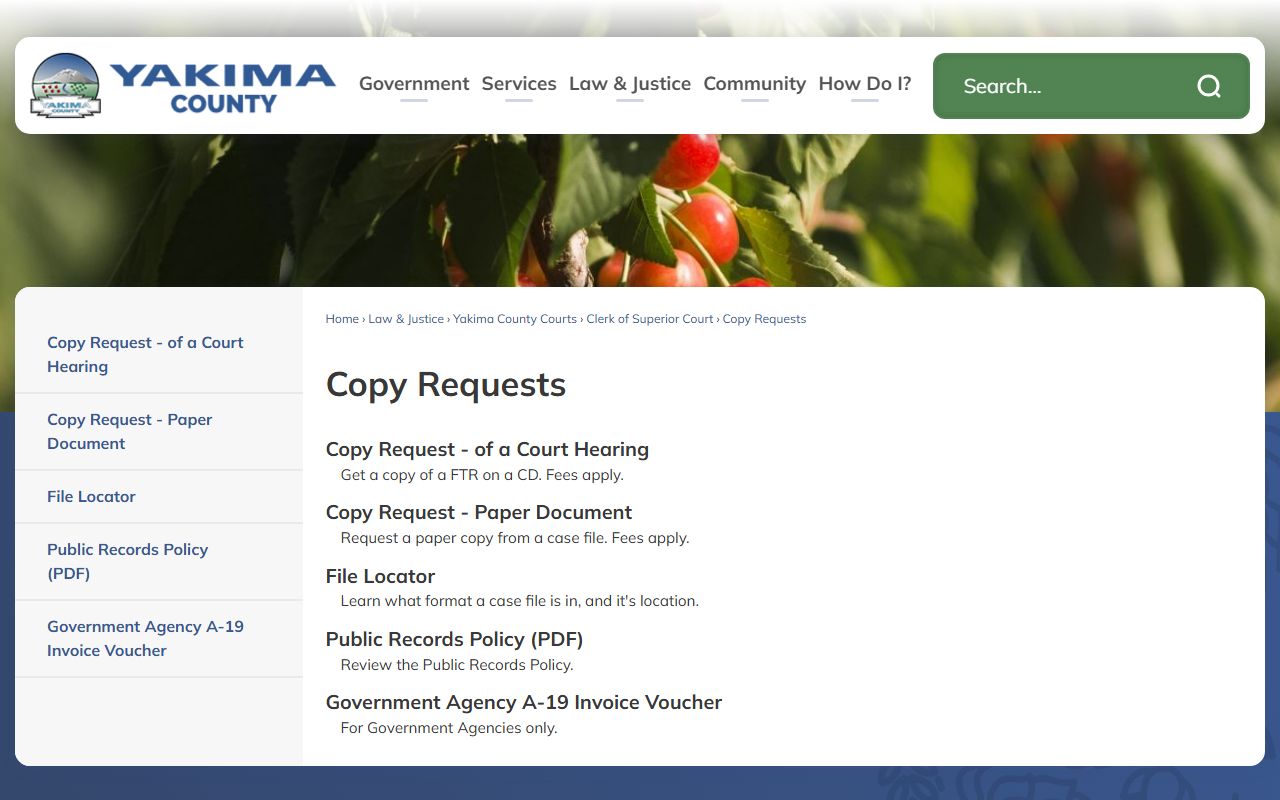
Use this page as your starting point for any Superior Court copy request.
Important: Sealed and confidential pleadings cannot be released without a court order, and a party or attorney who gets them is often given paper copies only because email is not secure.
Records Request Form Fields
The Clerk's online copy request asks for the details that let staff find your file and bill the right fee. The web form ties to the FormCenter copy request and the document copy process. The table below lists the fields the request relies on, drawn from the Clerk's copy and payment pages. Fill in what you know, since a missing case number can trigger a research charge.
| Field | Required | Notes |
|---|---|---|
| Requester / contact information | Yes | Name and contact details for the person asking and for delivery. |
| Case Number | Strongly advised | The official copy process relies on the case file; if missing, research fees may apply. |
| Case name / party name | Yes | Used to find the file when the case number is unknown. |
| Document / pleading requested | Yes | Name the pleading; sealed items need a court order or party/attorney status. |
| Copy type | Yes | Paper, electronic, certified, exemplified, or hearing CD are separate fee categories. |
| Payment confirmation number | If paid online | The nCourt confirmation number must be entered on the copy request. |
| Delivery method | Yes | Email is not offered for sealed or confidential material; paper may be required. |
You can see the live web form on the Clerk's FormCenter Copy Request.
The screenshot below shows the form layout used to order Superior Court case-file copies.
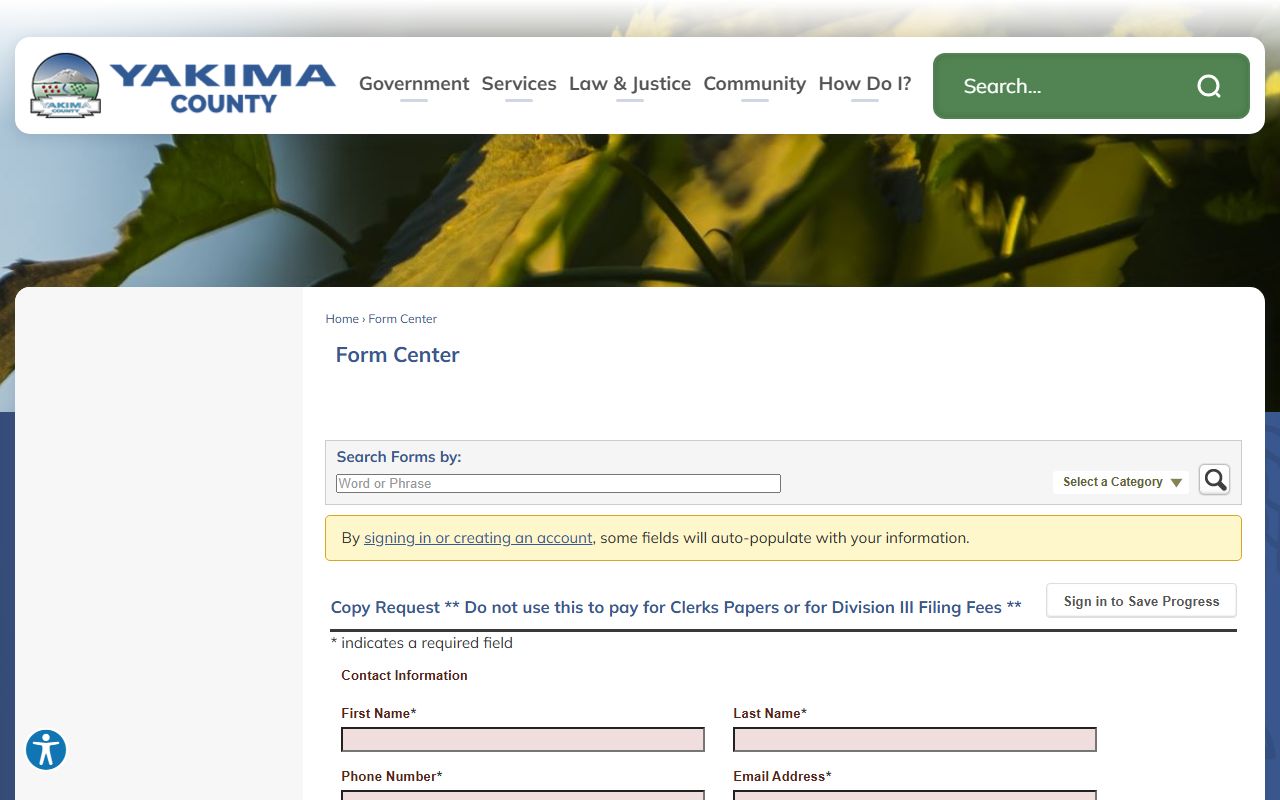
Complete each field, then submit and pay to start the request.
Yakima County Clerk Fees
The Clerk charges set fees for copies, certified documents, and searches. Paper copies cost more than emailed ones. Certified and exemplified copies cost more again, since staff must stamp and authenticate each one. If staff must dig through old files to find what you want, a research fee applies by the hour. These rates come from the Clerk's copy-fee page, the fee schedule, and RCW 36.18.016.
| Item | Amount |
|---|---|
| Paper copy per page | $0.50 ($1 minimum) |
| Electronic / emailed copy per page | $0.25 ($1 minimum) |
| Certified copy | $5 first page, $1 each added page |
| Exemplified / authenticated copy | $9 first page, $1 each added page |
| Court hearing CD | $25 per CD |
| Research / record search | $20 per hour of staff time |
| Handling fee (no stamped envelope) | $7 |
The county breaks the copy fees out on its Copy Fees page.
The image below shows the per-page and certified copy rates the Clerk lists.
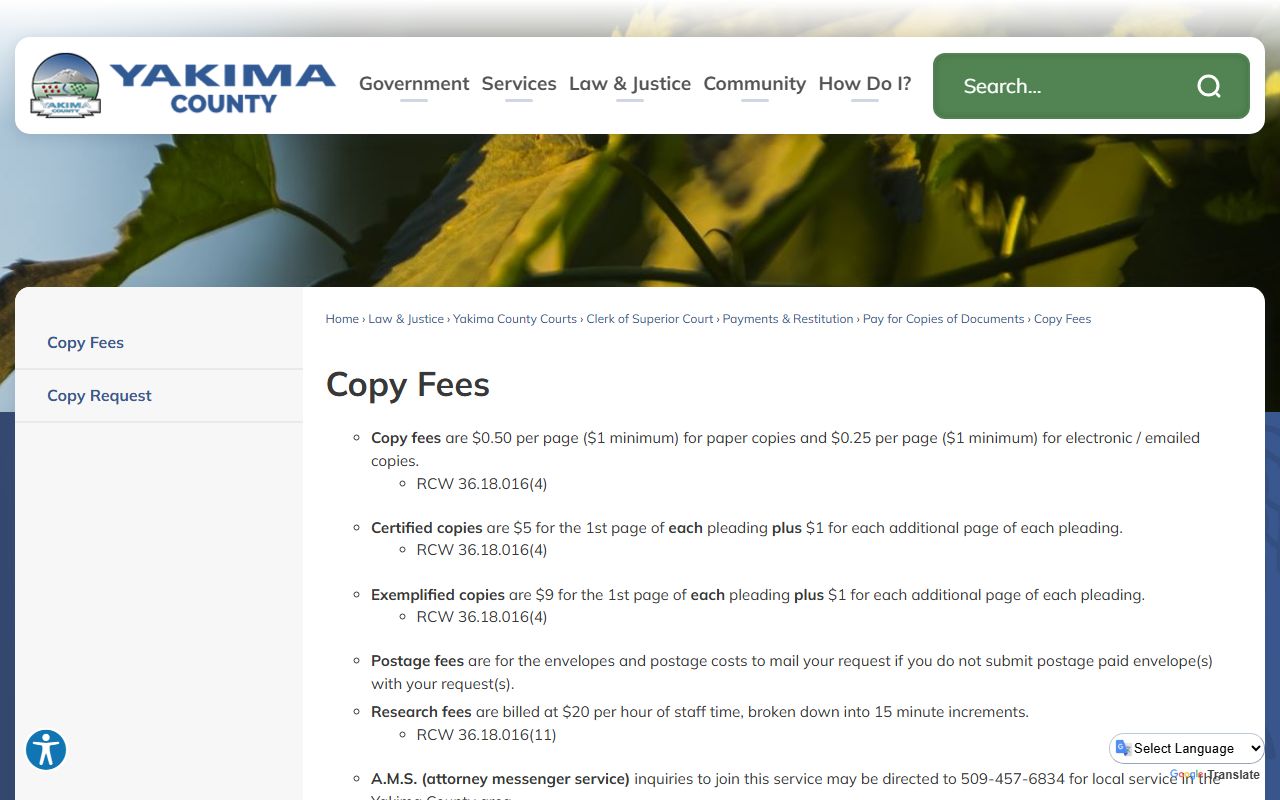
These per-page rates apply to most case-file copies.
The Clerk also keeps a full filing fee schedule for civil and family cases. A divorce, legal separation, or invalidity filing is $364, a domestic counter petition is $310, a civil appeal from a lower court is $280, a foreign civil judgment is $290, and an ex parte fee is $30. You can view the full list on the Fee Schedule and Price List page.
The screenshot here shows the price list and the link to the full fee schedule PDF.
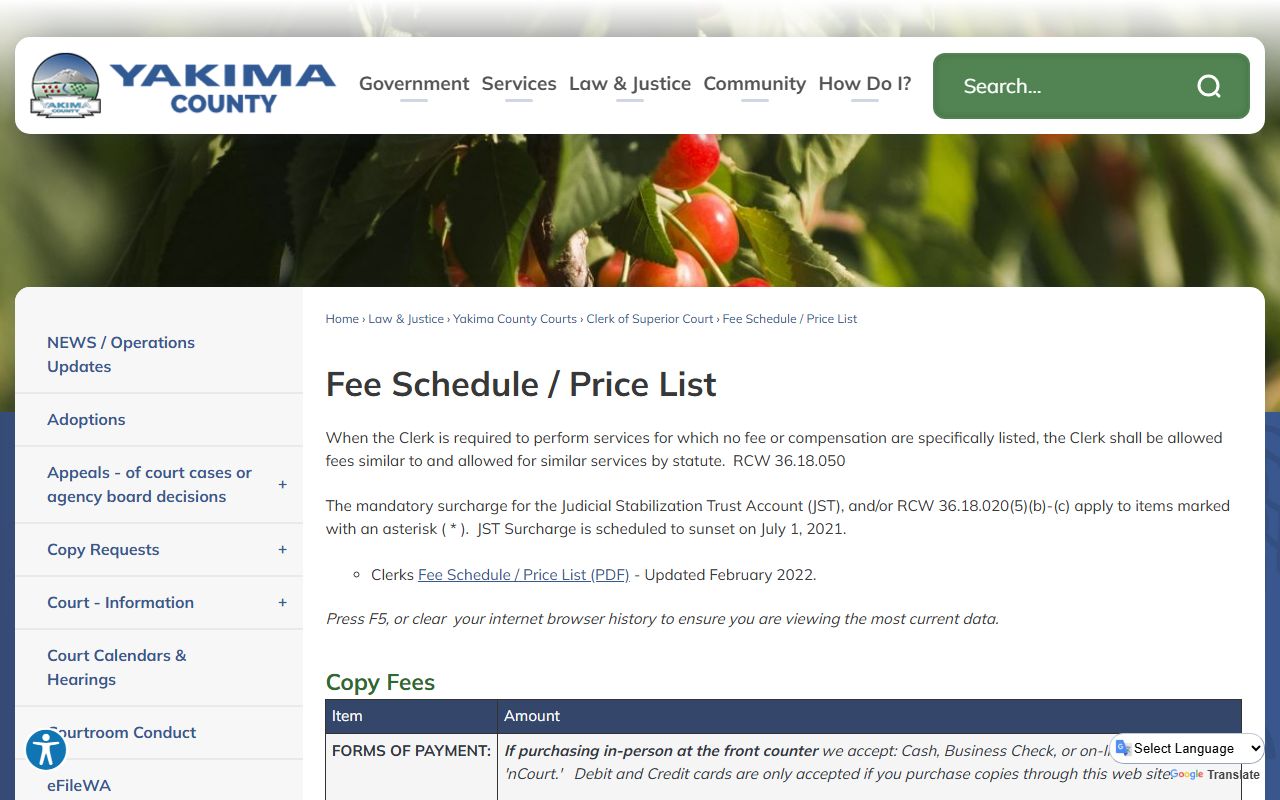
Check this page for filing fees before you submit a new case.
How to Pay for Copies
Payment rules depend on how you ask. At the front counter, the Clerk takes cash, business check, or online payment through nCourt. Debit and credit cards are accepted only when you buy copies through the website. For copies ordered online, you must place the nCourt confirmation number on the copy request, and the request is not worked until payment or that number arrives.
Timing matters. If payment or the confirmation number does not reach the Clerk within 30 days, the copy request is deleted and you start over. A Court of Appeals filing fee or Clerk's Papers should not use the document-copy process; instead, send a business check payable to Yakima County Clerk by U.S. Postal or attorney messenger service.
The county explains the full payment flow on its Pay for Copies of Documents page.
The image below shows the payment options and the sealed-record limits the Clerk spells out.
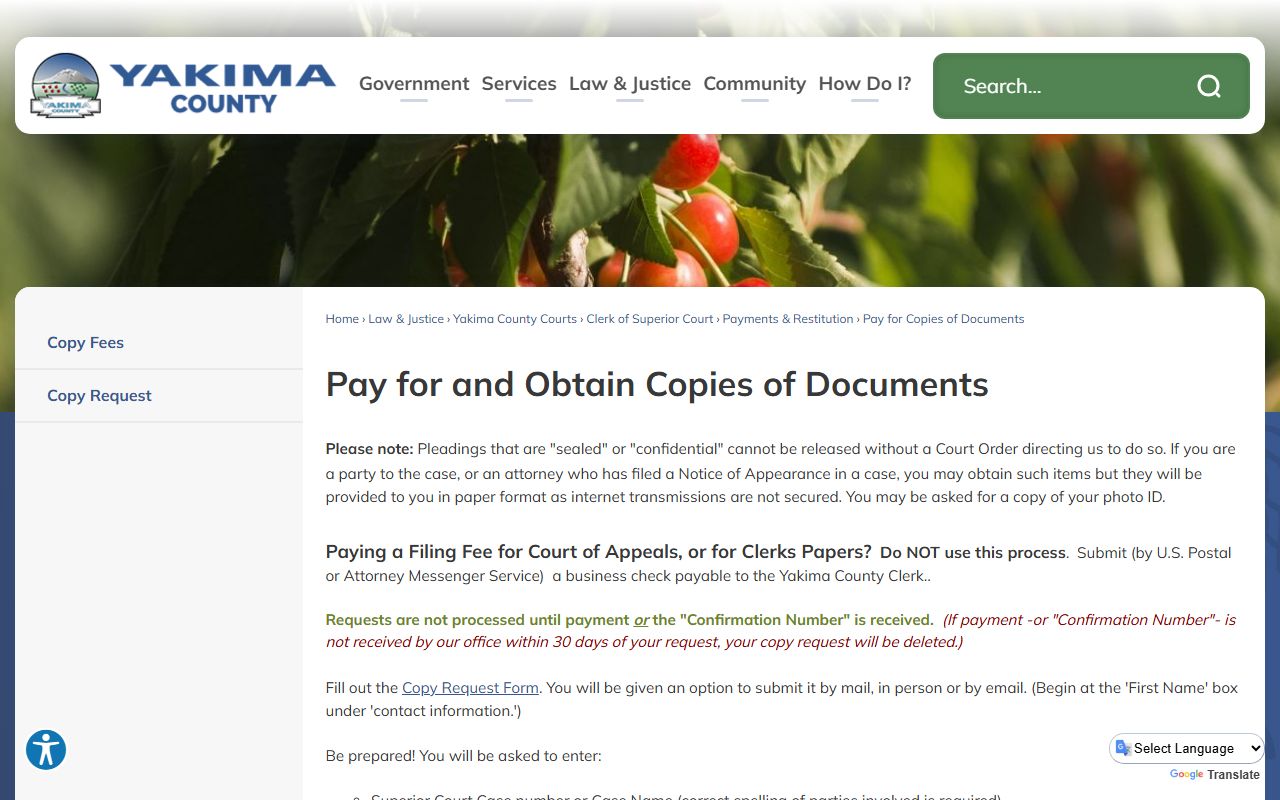
Read it before you pay so your request is not held or deleted.
Will Depository and Public Access Rules
One local service stands out. Since 2004, the Clerk has acted as a will depository. A living person may deposit an original will with the office for safekeeping until death. Those wills are not public record. The Clerk can confirm that a will was deposited, but cannot share its contents while the maker is alive. You can read about it on the Clerk's Wills, Probate, and Guardianship page.
Court records held by the Clerk are open or closed based on court rules, not the general open-records law. Washington General Rule 31 sets the access rule for court case records. They are open unless a federal law, state law, court rule, court order, or case law restricts them. The state Public Records Act, RCW 42.56, covers county departments but excludes the courts. So a Superior Court case file goes through the Clerk, not a public-records request. For more on probate filings and fees, see the probate records page.
Note: Always confirm a case number, party names, and the document type with the Clerk before you rely on a court file for any legal or financial decision.